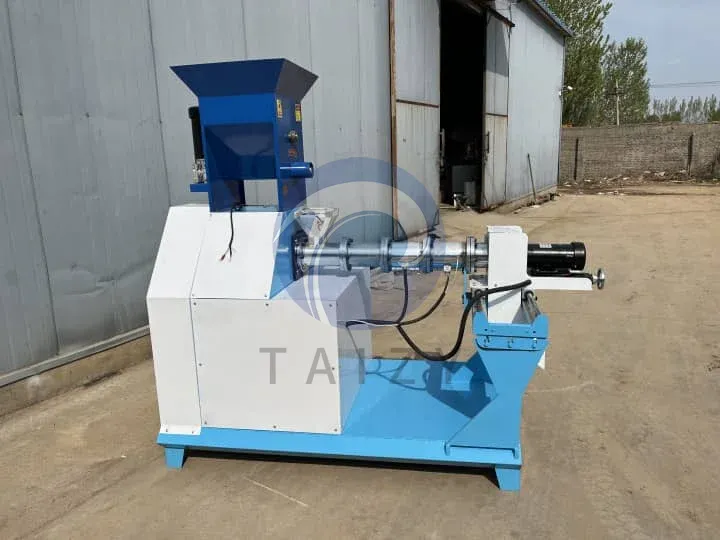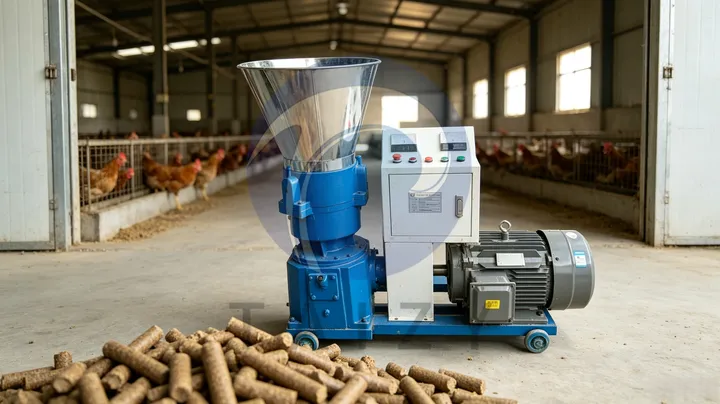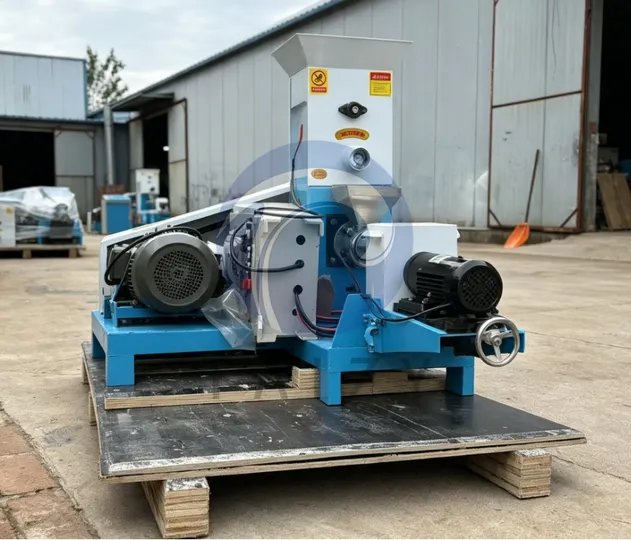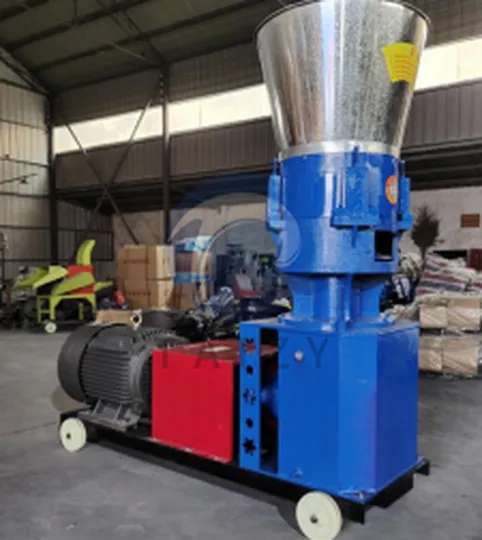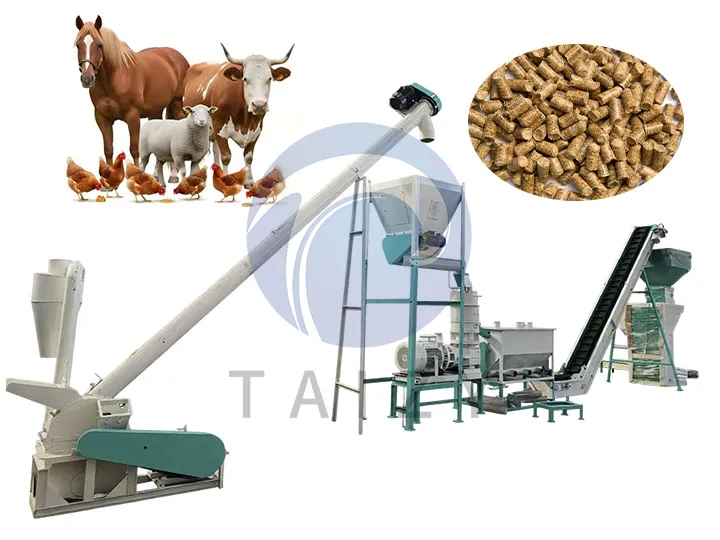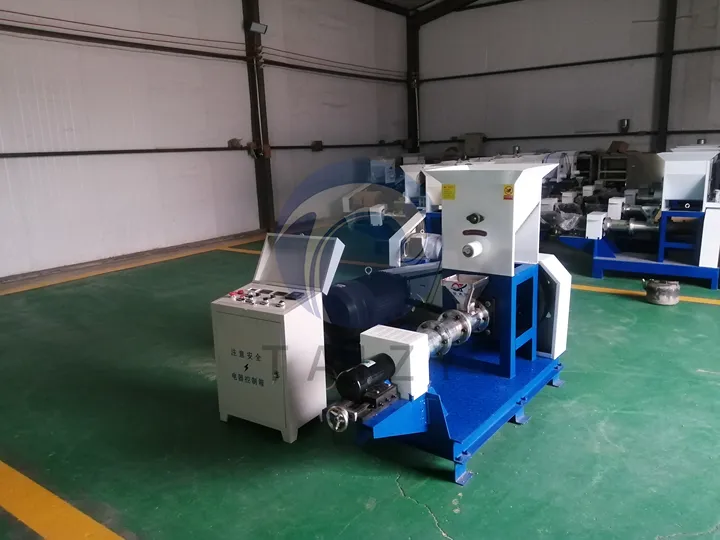
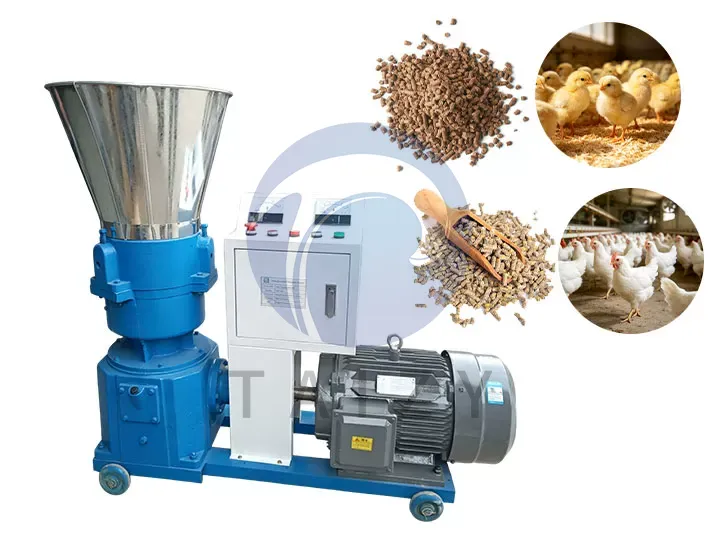
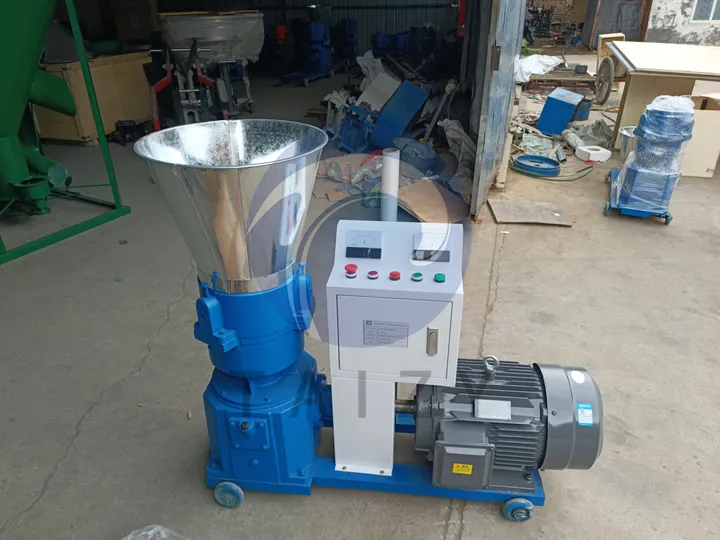
El chicken feed making machine is designed to process ingredients—such as corn, soybean meal, straw, and bran—into uniform pellets. With a maximum production capacity of 1,200 kg/h, it is suitable for small-to-medium-sized farms and commercial feed processing plants.
The machine is available with electric, diesel, or gasoline power options, allowing farmers to select the model best suited to local energy availability. Using this pellet machine, farmers can flexibly adjust feed formulations based on the specific growth stages of broilers, laying hens, or chicks.
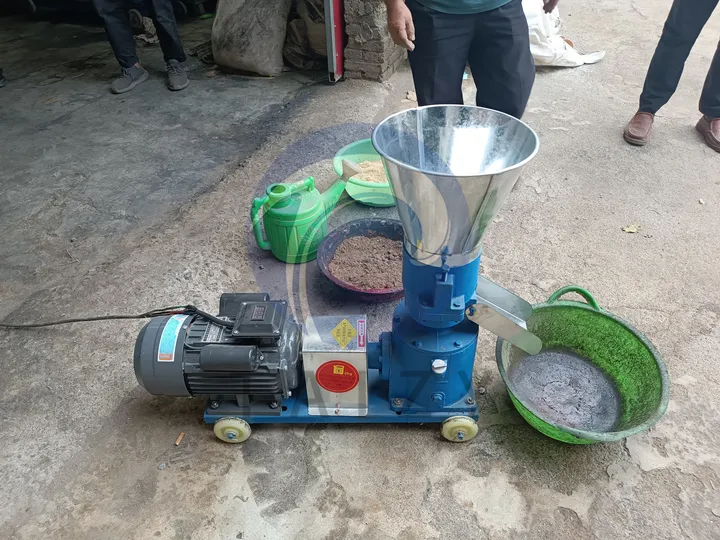
Features of the Chicken Feed Pellet Mill
- Easy to operate and clean, requiring only 1-2 workers.
- Parts are easy to replace, and maintenance costs for the pressure rollers and dies are low.
- The pelletizing process is visible, allowing for the timely detection and resolution of issues.
- The flat-die pellet machine can be powered by an electric motor, gasoline engine, or diesel engine, making it suitable for use worldwide, especially in areas with unreliable electricity supplies.
- The flat-die pellet machine features a compact, lightweight design for easy mobility, making it ideal for small-scale pellet production.
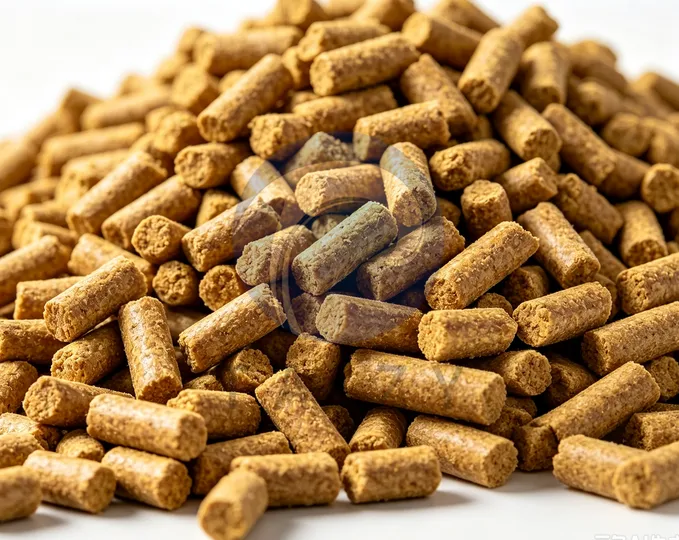
- Pellets are available in various diameters (2.5mm, 3mm, 4mm, 6mm, 8mm, 10mm) to meet the needs of different types of animals.
Chicken Feed Making Machine Parameters
| Modelo | KL-120 | KL-150 | KL-210 | KL-260 | KL-300 |
| Capacidad | 120kg/h | 150kg/h | 400kg/h | 800kg/h | 1000-1200 kg/h |
| Fuerza | 3kw | 3kw | 7,5 kw | 15 kW | 22kw |
| Mould plate diameter | 120mm | 150mm | 210mm | 260mm | 300 mm |
| Tamaño | 750*320*610mm | 750*350*650mm | 1000*450*960mm | 1460*460*1150mm | 1360*570*1150mm |
| Peso | 100kg | 190kg | 230kg | 360kg | 450kg |
What Can a Chicken Feed Making Machine Produce?
The machine can process a properly prepared mixture of common poultry feed ingredients into pellets.
Typical ingredients include:
- Corn or maize
- Harina de soja
- Afrecho de trigo
- Salvado de arroz
- Harina de pescado
- Bone meal
- Alfalfa meal
- Grass meal
- Other grain and protein ingredients
The exact formula depends on the chicken’s growth stage and nutritional requirements.
Pelleted Feed vs. Loose Feed for Chicken Feeding
| Aspect | Pelleted feed | Loose feed |
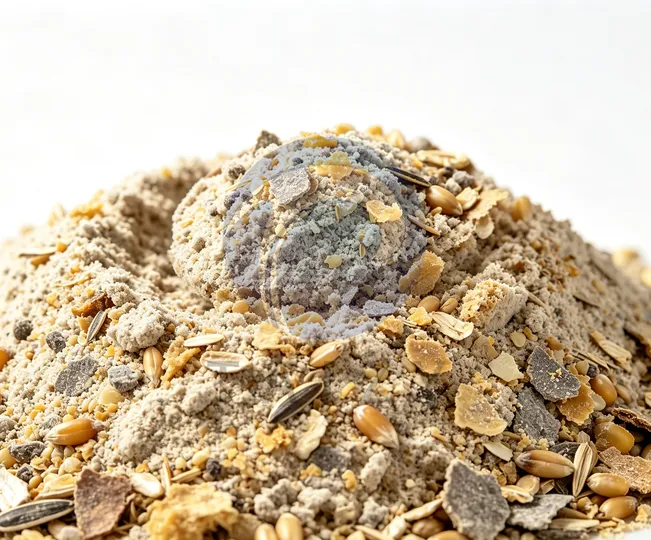
| Palatabilidad | Compact pellets are generally easy for chickens to peck and consume | Fine powders and separated ingredients may be less convenient to eat |
| Feed selection | Ingredients are compressed together, making it harder for chickens to selectively eat certain ingredients | Chickens may preferentially pick larger or more palatable ingredients |
| Feed intake | Uniform pellets make feeding more consistent | Feed particles can separate during feeding, resulting in uneven intake |
| Feed waste | Less fine dust and scattering can help reduce feed waste | Loose powder and small particles are more easily scattered |
| Chicken acceptance | Chickens generally adapt well to properly formulated pellets of a suitable size | Acceptance depends more on the texture and particle size of the mixed feed |
Why Do Poultry Farmers Make Their Own Chicken Feed?
The answer is different for every farm.
A farmer may have access to inexpensive local corn but face high transportation costs for finished commercial feed. Another may want to use farm-grown grain or adjust the feed formula according to the age of the chickens.
Making pellets on site can therefore offer three practical advantages:
Better use of locally available ingredients
Corn, wheat bran, rice bran, and other ingredients can be sourced locally and processed according to the farm’s own formula.
More flexibility in feed formulation
The same machine can produce different feed formulas after changing the raw material mixture. This is useful when a farm raises chickens at different growth stages.
Easier handling of prepared feed
Pellets are more convenient to transport and distribute than a loose mixture of multiple powders and grains.
Lower feed preparation costs
For farms with suitable local raw materials, producing feed on site can reduce reliance on ready-made commercial feed and help lower transportation and processing costs.
What Should Buyers Prepare Before Ordering?
Before choosing a chicken feed making machine, buyers should consider more than the machine’s output.
First, determine the required capacity. A family poultry farm and a commercial broiler farm may have very different daily feed requirements.
Second, check the raw materials. The particle size, moisture content, and formulation of the feed mixture affect the pelletizing process.
Third, select the appropriate pellet size. The die should match the intended chicken feed application.
Finally, consider the overall process flow. If the raw materials require additional steps such as crushing, mixing, cooling, and packaging, then a complete chicken feed production line would be more suitable.
Chicken Feed Making Machine for Customized Farm Feed Production
Want to produce chicken feed pellets from your own corn, soybean meal, bran, or other ingredients? Contact us to discuss your raw materials, required capacity, and pellet size, and we can recommend a suitable machine configuration.